Mar 11, 2025
The End of Points and the Rise of Liquid Loyalty
Most companies still treat loyalty like marketing - points, discounts, and rebates - but that logic is collapsing. In 2025, loyalty is infrastructure: fluid ecosystems, real-time intelligence, and liquid value that customers actually choose to live in.

There is a pervasive belief in business that "Loyalty" is a marketing function. It is viewed as a layer of icing on the corporate cake - a way to sweeten the deal for customers who are already eating.
This view is dangerously obsolete.
In the digital economy of 2025, loyalty is not marketing; it is infrastructure. It is the only defensible moat remaining in a world where distribution costs have trended toward zero and customer acquisition costs (CAC) have trended toward infinity. The brands that understand this are building "Emotional Ecosystems." The brands that don't are building "databases of indifference."
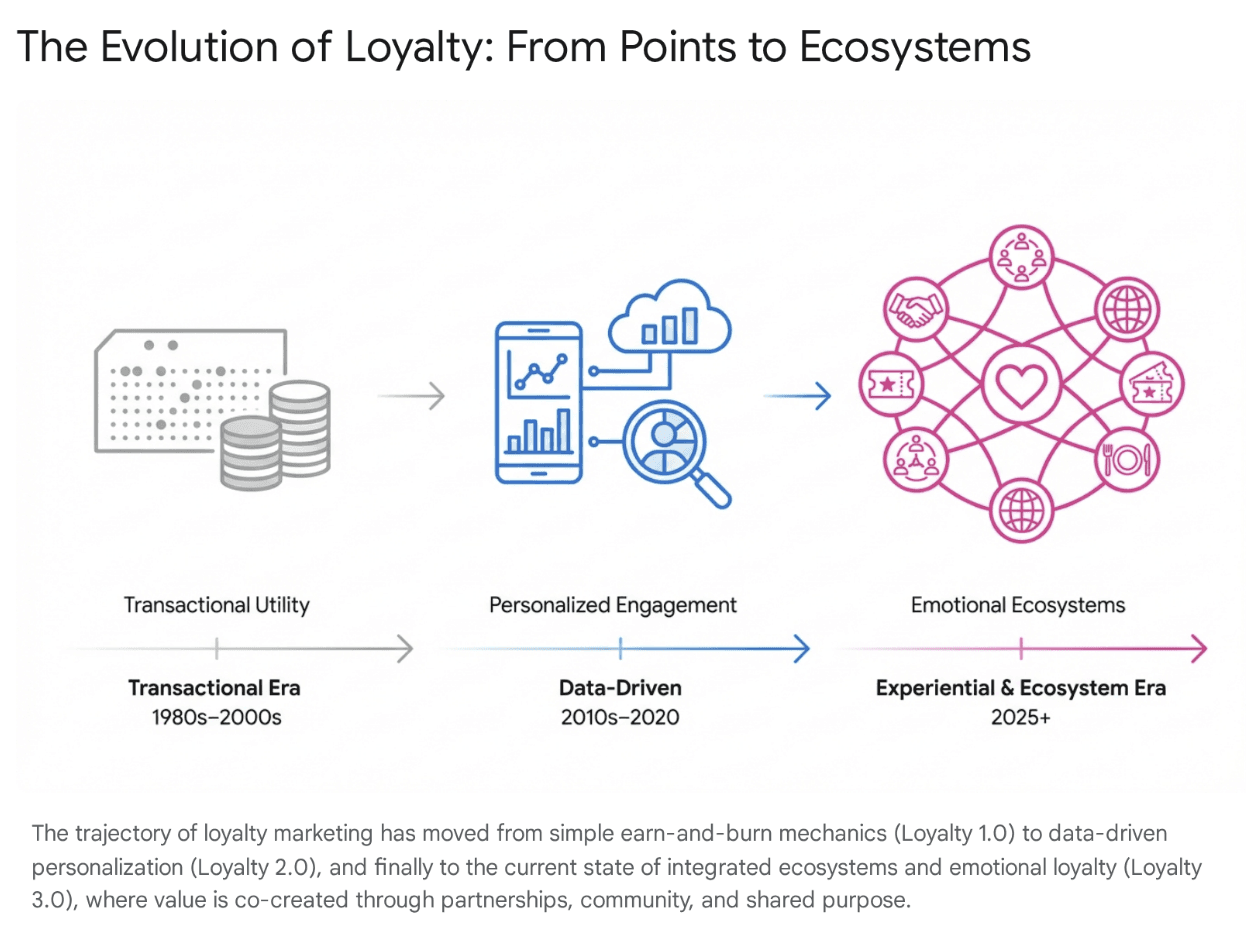
As we look at the $12.89 billion global loyalty market, we see a paradox that defines our current moment: Companies are spending record amounts to reach customers who care less than ever before. The average global consumer now belongs to 17 loyalty programs but is active in fewer than 30% of them.
To understand why this "Loyalty Inflation" is happening, and how to escape it, we must first understand the economic history of the "point," the theoretical architecture of the "experience," and why the current technology stack is fundamentally broken.
The Services Trap and the Red Queen
In 1998, B. Joseph Pine II and James H. Gilmore published a seminal article in the Harvard Business Review titled "The Experience Economy." They argued that economic value progresses through distinct stages:
Commodities: Extracting coffee beans (fungible).
Goods: Roasting and packaging beans (tangible).
Services: Brewing a cup of coffee for a customer (intangible).
Experiences: Staging a memorable event around the drinking of coffee (memorable).
For the last twenty years, the loyalty industry has operated firmly in the Services Economy.
The model, pioneered by American Airlines with AAdvantage in 1981, was transactional arbitrage: "Buy a flight (Service), get a mile (Rebate)." This model worked brilliantly when it was novel. It created a "lock-in" effect that forced high-value business travelers to consolidate their spend.
However, in 2025, "points for purchase" has become a commodity itself. When every coffee shop, airline, and D2C sock brand offers a "spend $100, get $5" program, the differentiator vanishes. This creates what evolutionary biologists call a Red Queen Effect: you have to run faster and faster (issuing more points, offering deeper discounts) just to stay in the same place.
The data bears this out. While loyalty membership has ballooned to 20+ programs per user, active engagement has flatlined. We are seeing a "commoditization of loyalty" where the program is no longer a reason to stay; it is merely a hygiene factor. If you don't have one, you lose; if you do have one, you don't necessarily win.
To escape this trap, brands must ascend to the Experience Economy. They must stop selling "services" (discounts) and start staging "transformations."
The Four Realms of the Experience Economy
Pine and Gilmore’s framework provides a diagnostic tool for why most modern loyalty programs fail. They categorize experiences into four realms based on Customer Participation (Active vs. Passive) and Connection (Absorption vs. Immersion).
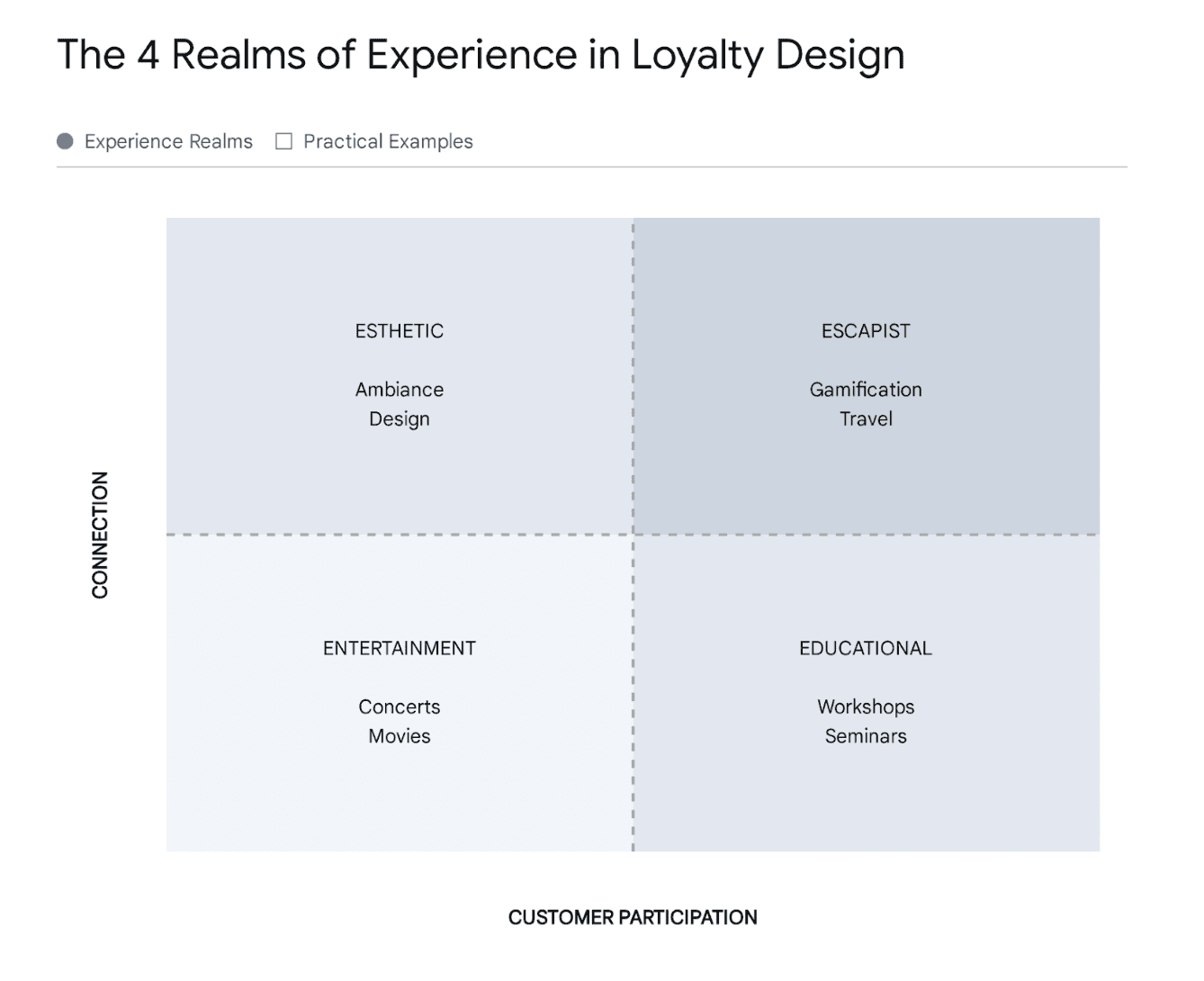
Most legacy loyalty programs sit in a "null zone" - they offer neither absorption nor immersion. They are purely transactional calculators. A successful program in 2025 must operate across these four realms:
1. Entertainment (Passive Absorption)
This is the realm of "sensing." It is where the customer passively absorbs an experience.
The Failure: Sending a generic email saying "Happy Birthday, here is 10% off."
The Success: American Express giving cardholders early access to Taylor Swift tickets. The cardholder doesn't perform the concert, but their access to it creates a halo of value around the membership.
The Quboid Vector: By using Qurious AI to analyze social signals, a brand can trigger rewards that entertain - like unlocking exclusive digital content or a "behind the scenes" stream - based on a user's stated interests, rather than just their transaction history.
2. Educational (Active Absorption)
This is the realm of "learning." The customer actively engages mentally to increase their capability.
The Failure: A "How-To" manual on a website.
The Success: Sephora’s Beauty Insider, where users earn points for attending in-store makeup classes. The loyalty program isn't just about buying lipstick; it's about becoming better at applying it.
The Quboid Vector: B2B programs like Lenovo LEAP use this mechanic perfectly. Partners don't just earn for selling; they earn for learning about new products. This creates a "Knowledge Moat"—a partner who is educated on your product is structurally less likely to switch to a competitor.
3. Escapist (Active Immersion)
This is the realm of "doing." The customer participates in a way that shapes the environment.
The Failure: A static progress bar that says "Spend $50 more to reach Gold."
The Success: Starbucks for Life or Nike Run Club. Here, the loyalty program is a game. The customer is an active player, chasing streaks, badges, and leaderboards. This taps into the same dopamine loops as video games.
The Quboid Vector: This is where Quboid’s Gamified Experiences infrastructure shines. By deploying "Quests" and "Streaks" (e.g., "Visit 3 different store locations this month"), brands can drive frequency by +20-40%. The program becomes an escape from the mundane transaction.
4. Esthetic (Passive Immersion)
This is the realm of "being." The customer is immersed in an environment but has no effect on it.
The Failure: A cluttered app interface filled with banner ads.
The Success: An airport lounge. You don't "do" anything in a lounge; you simply are there. The value is the ambiance and the exclusion of the chaos outside.
The Quboid Vector: Token-gated access. Imagine a fashion brand issuing a "Genesis Token" to its top 100 customers. Holding this token in their wallet automatically changes the website interface they see, removing ads and unlocking a "VIP aesthetic." This is purely software-defined luxury.
The Infrastructure Gap: Why You Can't Build This on Salesforce
If the theory is so clear - move from Service to Experience - why are so few brands doing it?
The answer lies in the Stack.
The current marketing technology stack (MarTech) was built for the Services Economy. It is a series of disconnected silos:
The POS (Point of Sale): Knows what you bought.
The CRM (Customer Relationship Management): Knows who you are.
The CDP (Customer Data Platform): Knows what you clicked.
The ESP (Email Service Provider): Knows what was sent.
These systems do not talk to each other in real-time. When a customer has a bad experience at checkout (POS), the ESP doesn't know about it until the nightly batch update runs 24 hours later. By then, the moment is gone. The reward doesn't land in the "moment that matters".
This fragmentation creates a "Passive Audience." Brands are paying to acquire data, but they lack the infrastructure to trigger immediate behavior. They are data-rich but action-poor.
The Solution: The Engagement Multiplier Engine
To solve the "17 programs, 3 active" problem, we need a new architectural layer. We need an engine that sits above the silos and orchestrates value in real-time.
This is the architectural thesis of Quboid.
Quboid fixes the infrastructure gap through three specific mechanisms that transform "Static Points" into "Liquid Loyalty."
1. Tokenization: The End of "Fake Money"
In a traditional program, points are entries in a SQL database. They are a liability to the CFO and "fake money" to the consumer. They have no utility outside the walled garden. Quboid uses Blockchain to tokenize loyalty assets. This turns points into programmable, liquid assets.
Why this matters: It enables Interoperability. A user can earn tokens on their morning coffee (Brand A) and redeem them for a discount on a flight (Brand B). The user perceives the points as "real money" because they have liquidity.
The Metric: This liquidity drives a 3.5x lift in redemption rates. When customers know they can actually use the points, they bother to earn them.
2. The Multi-Brand Network: Breaking the CAC Loop
Standalone loyalty programs suffer from the "Cold Start" problem. You have to pay Facebook or Google to acquire every single member. Quboid operates a Multi-Brand Network of 2.8 million users. When a brand joins Quboid, they aren't building from scratch; they are plugging into an existing ecosystem of high-intent buyers.
The Strategic Shift: This moves loyalty from "Customer Retention" to "Community Acquisition." Brands can acquire customers from complementary partners (e.g., a luggage brand acquiring customers from a travel booking platform) at zero incremental ad spend.
The Result: A reduction in CAC by 23-40%.
3. AI as the "Decision Layer"
Finally, Quboid replaces the "nightly batch update" with Qurious AI. Qurious AI is an agentic layer that watches the data stream. It doesn't just report on the past; it predicts the future.
Use Case: If a high-value customer encounters a "403 Forbidden" error or a payment decline at checkout, Qurious AI detects the frustration signal in real-time. It can instantly trigger an apology reward or a "Recover Cart" offer via WhatsApp before the user even closes the tab.
The Shift: This moves personalization from "Marketing Logic" (Segments) to "Service Logic" (Solutions).
Conclusion: From Renters to Owners
The trajectory of the loyalty market is clear. We are moving from a world of "Renters" - where brands rent attention from ad networks and rent loyalty via discounts - to a world of "Owners."
By owning their infrastructure, owning their community, and owning the "Liquid Asset" that binds them together, brands can escape the Red Queen race. They can stop competing on the commoditized "Service" layer and start competing on the "Experience" layer, where margins are higher and customers are stickier.
The future of loyalty isn't about who has the most points. It's about who has the most fluid ecosystem.